PASS One
|
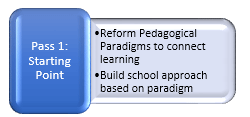
An early trajectory for my research centered around bettering K-12 education through development of a paradigm that teachers might truly comprehend and be therefore empowered to implement change. |
||

PASS Two
In collaboration with the cohort, my original ideas were picked at and refined:
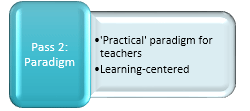
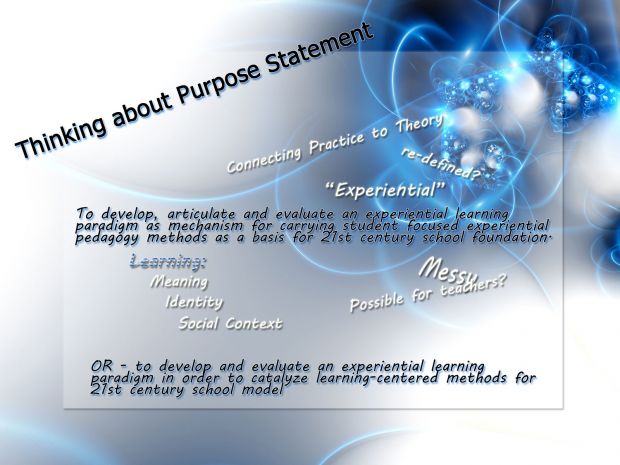
…to develop and evaluate an experiential learning paradigm in order to catalyze learning-centred methods for a 21st century school model.
|
Which lead to the following research purpose statement:
The purpose of this study is to develop and evaluate a ‘practical’ paradigm for experiential learning to catalyze teacher, and thus, school transformation toward learning-centered pedagogy.

PASS Three
|
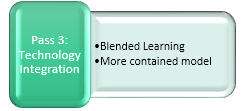
Coming to the realization that the scope of my original research interest was far too large, I began seeking inroads toward bettering K-12 education practices. This quickly lead me to considering teaching in the context of technology - could the processes and mindsets around the adoption of technology be a stepping stone toward creating a new pedagogical paradigm? Here is an excerpt of this Pass's thinking: |
||
Most schools today still operate consistent with their birth and conception in the industrial age – a model of mass production and a mold of ‘one size fits all’. “Conventional school is like a school bus rolling along the highway, with the teacher standing at the front and pointing out interesting and important sights but telling the passengers that, no, we cannot let you get off to explore what’s down that side road.”[i]
A ‘good’ blended application of learning combines the strengths of face to face instruction and online learning technologies and aims to increase student learning. A psychological study of learning and study habits in Applied Cognitive Psychology illustrates that interleaving practice and review significantly (nearly doubles) student retention and performance.[ii] Where designed properly, a synergy between online and traditional face to face instruction should create the conditions necessary for a more active learning environment.
One major difficulty affecting schools and faculty working to adopt a blended learning approach is that there are very few guidelines or conceptual models available for this paradigm of education. Given the multiplicity of curricular contexts and the near limitless solutions for employing ‘blended learning’, how should teachers go about creating a blended environment? What conceptual frameworks will best serve and aid in the development of blended contexts?
Propose best practices/conceptual frameworks for inclusions of online learning within educational practices based on student and faculty experiences, taking into account subject area, etc.
[i] Kolderie, T., McDonald, T. 2009. How Information Technology Can Enable 21st Century Schools. The Information Technology & Innovation Foundation
[ii] Taylor, K., Rohrer, D., 2010. The Effects of Interleaved Practice. Applied Cognitive Psycology 24: 837-848

PASS Four
|
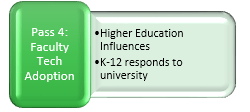
Further refining my research focus, the scope of understanding technology integration in instruction was limited to that of university faculty. I pondered the possibility that research in the university adoption area would lead to a better understanding of the "trickle-down" effect to K-12 schools and their push or resistence to integrating technology in instruction and learning. |
||
A small scale example of our school systems’ inability to reform teaching methods is seen within university faculty’s adoption of technology integration. As can be seen in a myriad of recent news reports and anecdotal surveys throughout North America, online learning strategies are being both heralded for the opportunities they represent and scolded for robbing students of authentic interaction and connection. Levels of employment and engagement with blended online learning strategies by university professors are very inconsistent as a result of “the human factor” (Renes & Strange, 2011) and preconceived perceptions (Niemiec & Otte, 2010).
The purpose for this study is to explore the underlying perspectives, the human factors which breed resistance or engagement with online learning methods among higher education professors. What are the road blocks to adoption of blended learning by faculty, and similarly what attitudes elicit adoption and engagement?
References
Niemiec, M., & Otte, G. (2010). An Administrator’s guide to the whys and hows of blended learning. Journal of Asynchronous Learning Networks, 13(1), 19-30.
Renes, S. L., & Strange, A. (2011). Using Technology to Enhance Higher Education. Innovative Higher Education, v36 n3, 203-213.

PASS Five
|
Following many drafts, conversations, readings and consultations with Dr. McClaren I settled on a research topic, its scope and detail. I began working toward completing all detail required for the Department of Research Ethics and in so doing, ironed out many wrinkles in the planned approach. Below is a summary of the purpose and goals of my study. The full Study Detail can be viewed on the Study Detail page. The version shown has been accepted by SFU's Department of Research Ethics and granted approval. |
||
Purpose and goals of the study
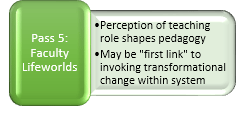
The proposed study will seek to understand how university faculty think about their teaching responsibilities and how they view the effects of educational technologies and media on their instructional work. Additionally, the study will document and analyze the induction of new faculty including processes employed, training received, and mentoring relationships established.